
I thought I knew David Hockney’s work.
I had first encountered it in Bradford in 1983, where I saw many of his photographic collages and some of the Los Angeles pool paintings. Those works stayed with me, but they also became the frame through which I understood him.
The 2023 exhibition at the Museum of Contemporary Art Tokyo broke that frame open.
I had not appreciated the scale of the work, or its breadth across painting, drawing, photography, video and digital media. The exhibition did not present a painter who had occasionally experimented with technology. It revealed an artist repeatedly changing the means by which he looked.
In Mr and Mrs Clark and Percy, the coffee table projects towards the viewer as though it occupies the gallery rather than the painted room. The rug, the light and the distance between the two figures turn a familiar double portrait into something less settled. Standing in front of it, I did not feel outside the scene.
Looking in parts
Hockney’s large works do not always begin with a large, single surface.
Bigger Trees Near Warter extends across fifty canvases. The complete painting is monumental, but its construction remains visible. It asks you to see the landscape as a whole while remaining aware that the whole has been assembled from separate views.
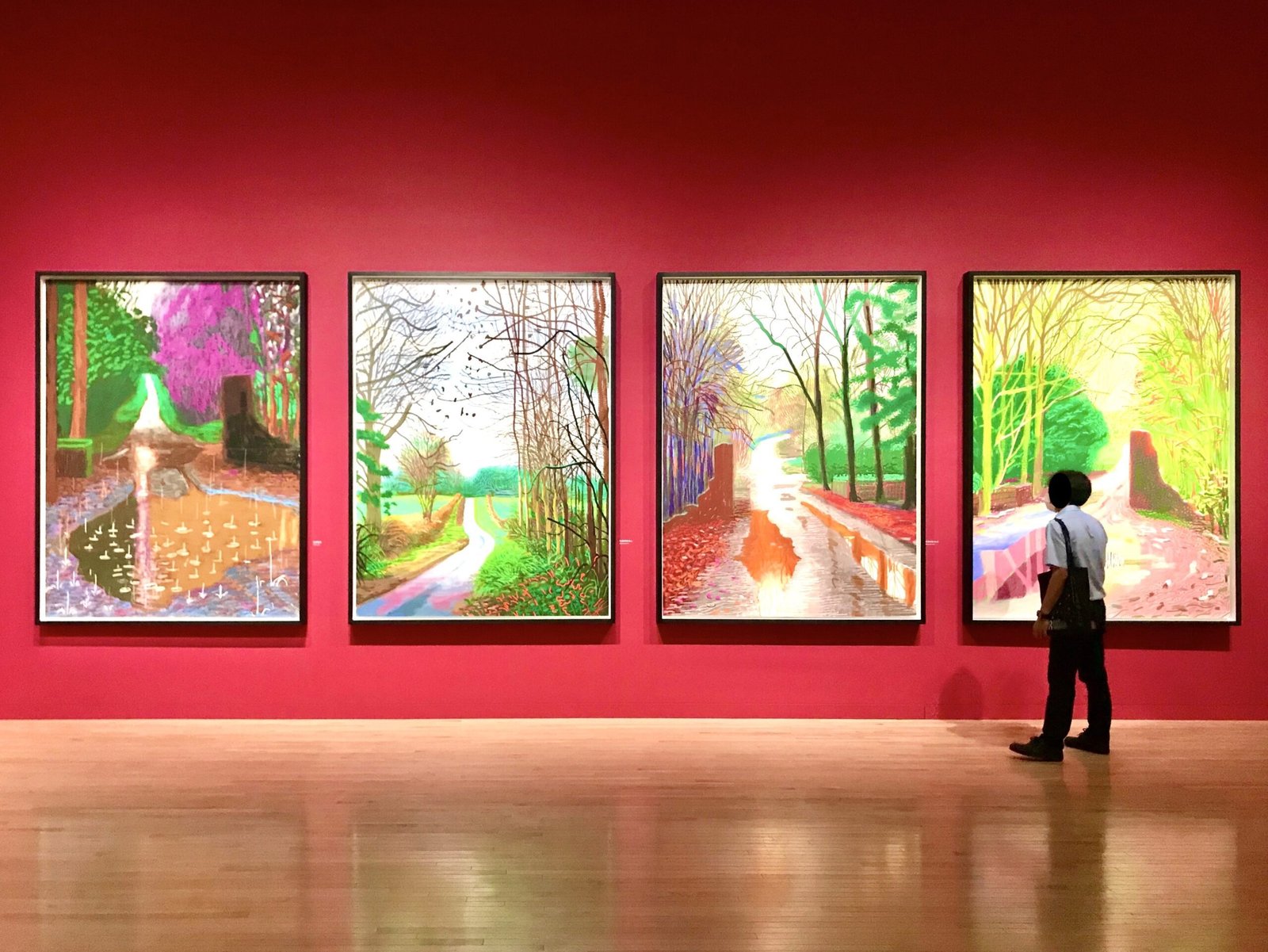
The Arrival of Spring in Woldgate, East Yorkshire works similarly across thirty-two canvases. Colour and movement pass between them, but the divisions prevent the landscape from settling into one fixed window.
This connected with what I already knew of Hockney’s photographic collages. A camera usually offers one position and one instant. Hockney accumulated photographs, shifted the viewpoint and allowed time to enter the image.
Painting, photography and digital drawing became different ways of returning to the same question: how much of looking can one image contain?
Walking through a year
A Year in Normandie carries that question across ninety metres.
Hockney drew the work on an iPad over the course of a year, connecting views of the landscape from his garden. Its inspiration was the Bayeux Tapestry, but the event unfolding here is the passage of the seasons.
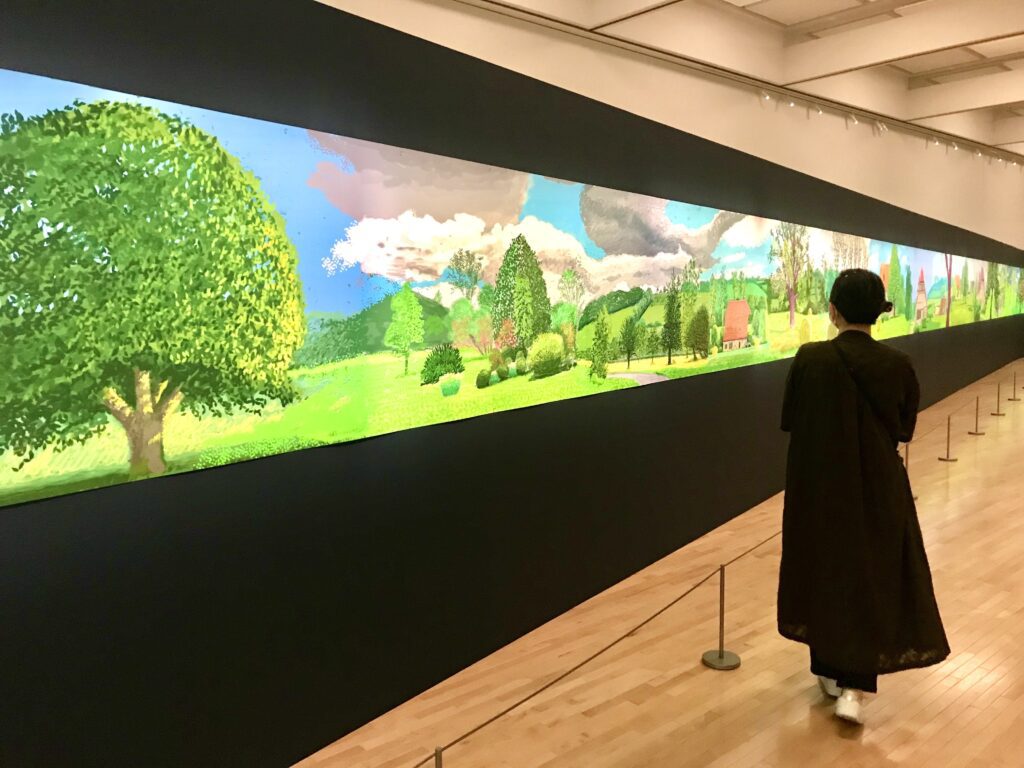
A reproduction reduces the work to something that can be seen at once. In the gallery, I had to walk alongside it. My movement became part of the viewing, and time entered from both directions: the year Hockney recorded and the minutes it took me to pass through it.
Where an artist chooses to live
The exhibition also made me reconsider what the life of an artist can be.
Hockney’s changes of place were changes in the work. Los Angeles gave him swimming pools, hard light, modern houses and a particular social world. Returning to East Yorkshire brought roads, trees and the repeated arrival of spring. In Normandy, the view from his garden became A Year in Normandie.
Place was not merely background.
Where an artist chooses to live determines what remains close enough to observe repeatedly. It also says something about the distance that person seeks—or needs—from society and from other people.
I cannot know what each move meant to Hockney privately. But the work records a changing relationship with human company: portraits and domestic interiors; the constructed social world of Los Angeles; then landscapes watched closely over days, months and seasons.
The conventional image of an artist’s career is a steady development towards an identifiable style. Hockney’s example suggested something less fixed: a life rearranged several times, with each new place and medium offering another way to look.
The exhibition did not simply show me more Hockney. It changed the Hockney I thought I knew.