
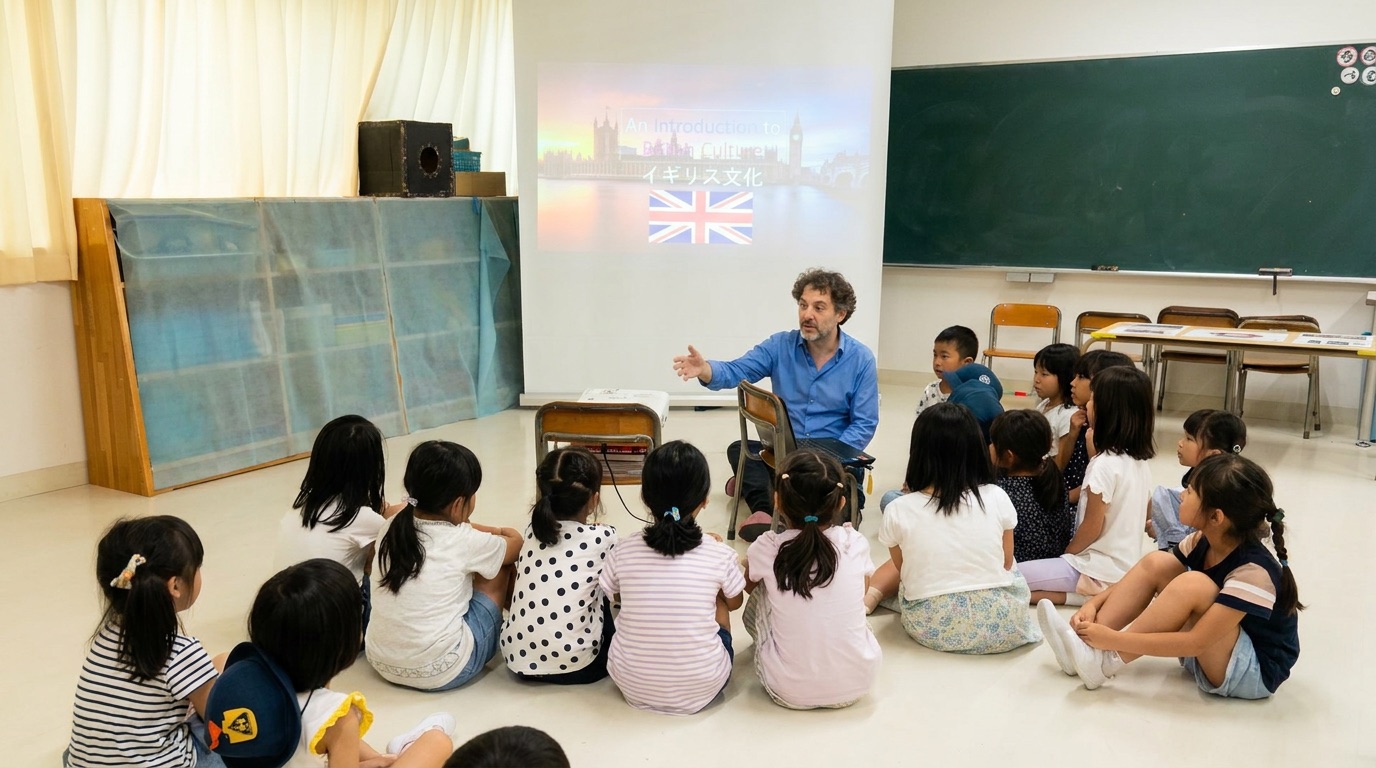
Why that’s harder than it sounds in a Tokyo elementary school.
The slide behind me reads An Introduction to British Culture. The audience is a room of Japanese six-year-olds sitting on the floor, and almost none of them speak English.
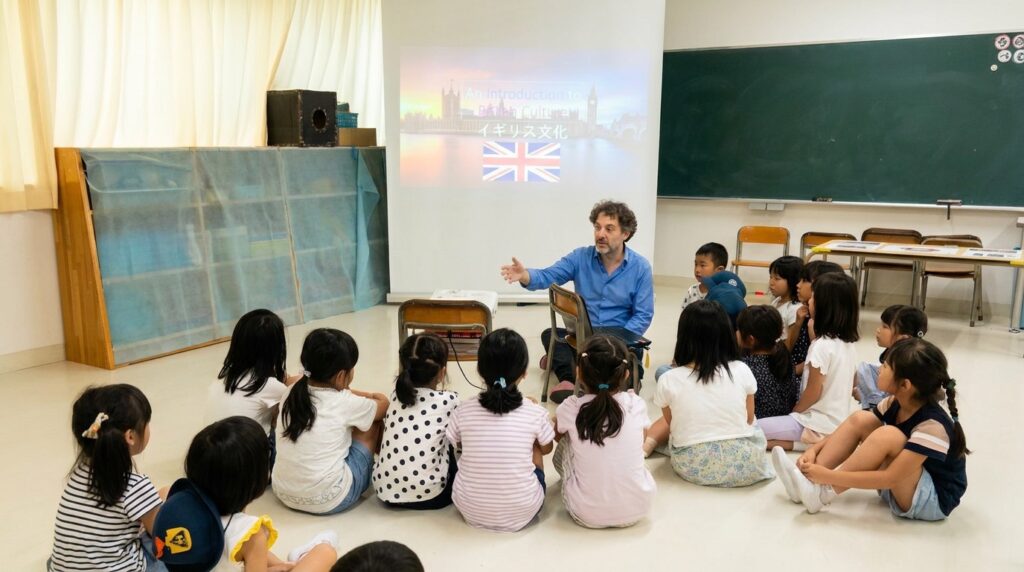
These come through the Itabashi Cultural and International Exchange Foundation, which has asked me to run several at elementary schools around Tokyo. The brief is as broad as it sounds: Britain, for children who have never been there and may never go.
Forty minutes and no shared language means explanation is off the table. So we turned the room into the Underground. Every child got a landmark card — Charing Cross, Trafalgar Square, the Shard — and had to find their station, with video running and the sound of a train pulling in and a guard shouting “Mind the doors.”
That last part is the bit I’d defend. Every child in that room already knows a metro — the platform, the crush, the little melody that plays as the doors close. I wasn’t handing them something foreign. I was handing them the thing they know best, relocated: same platform, same doors, and a man shouting instead of a tune.
Do that well enough and you can give someone the experience of travelling to a foreign city without their leaving the room.
Not every request is like that. The same foundation has asked me to talk about the SDGs as they’re applied in Britain — that time to secondary students with much stronger English, and a translator in the room. A different problem entirely: when the audience can follow an argument, you stop showing and start explaining.
So they got the published figures on energy use and food waste, and photographs of how recycling is actually handled day to day — and then a warning not to take any of it at face value. A recycling rate measures what goes into the bin, not where the material ends up.
The rest of the teaching is less photogenic. I’ve taught ESL at LinguRing International Language School since 2019, and English and music privately alongside it. Before that, music and language acquisition in IB international schools — Sakura International Academy and Gakugei University International Secondary School — and film music composition and theory at Andvision International Music School, 2021–2025.
Which is the same problem I spend the rest of my working life on. A dome, a headset, a score — every one of them is an attempt to put somebody somewhere they aren’t. The classroom version just needs a projector and a recording of a train.