
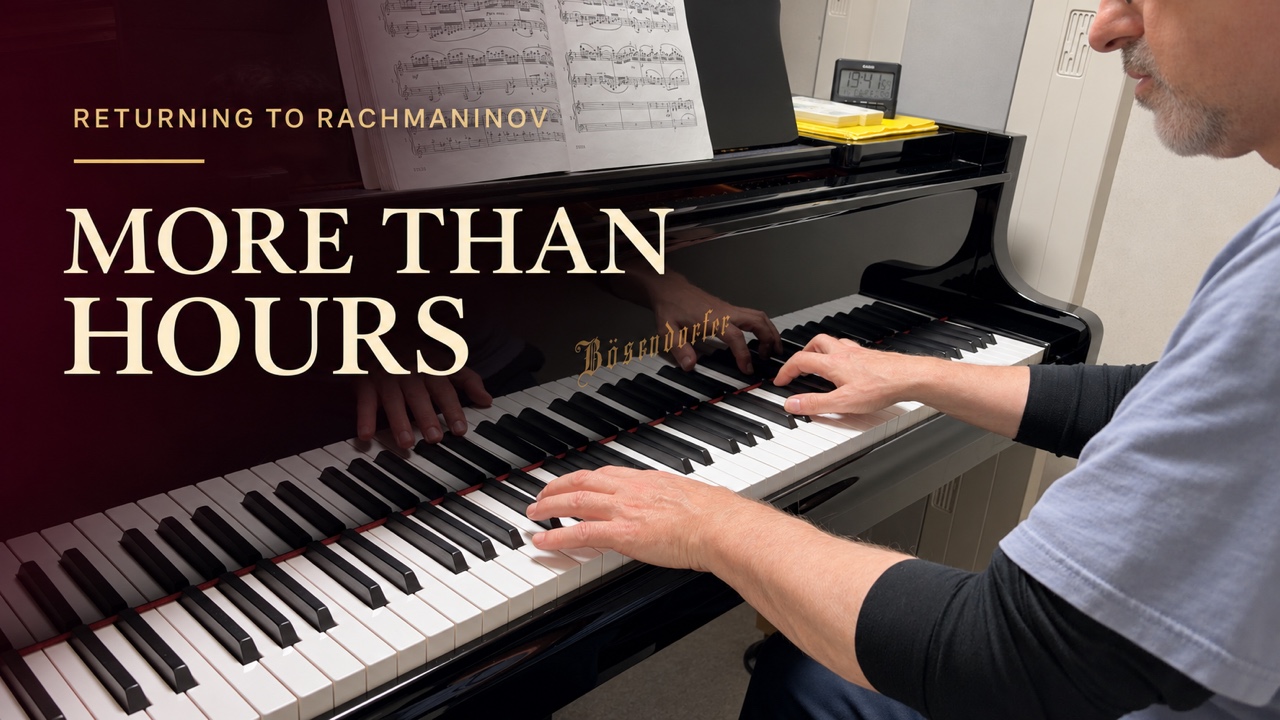
I’m relearning Rachmaninov’s Paganini Rhapsody nearly thirty years after I last performed it, having played very little piano in between. In October I committed to regular practice. The last six weeks haven’t gone to plan. Finding the time, getting access to the right piano and filming as I go have all slowed things down.
Even so, the hours I have put in keep circling one question I’ve had for years. What does it actually take to play at the highest level? Training, environment, good instruments? Or things you’re born with?
I had a lot going for me. Cello at five with a professional teacher, and a mother who sat in every lesson taking notes. A father who was a professional musician. Five years in the Christ Church choir. I can roughly estimate the hours I clocked. I can’t vouch for their quality, and at the piano I’m largely self-taught.
Coming back to Variation 15, what surprised me was what had survived. The fine control of hitting every right note was gone. But many of the wrist and arm movements were still there, and my hands wanted to shift position at the same moments they used to, in places where my score has no fingering at all. Motor research helps explain some of that. At speed the brain groups a run of notes into a single gesture rather than reading them one by one, and those gestures seem to last far longer than the finger conditioning underneath them. Right now the small chunks work. The hard part is stitching them together without an error at the seams.
I’ve also learned that not all hours do the same thing. Of maybe eight hours on Variation 15 recently, a good share was playing it straight through for the camera. That tests where you are, but it doesn’t fix anything. Real practice is stopping, isolating the two beats where tension creeps in, and retraining the movement. Even so, I think some fast practice is essential before a passage is clean. Fast playing uses different arm weight and momentum, and sometimes you have to feel the passage at tempo to learn the motion your body needs.
Then there’s the instrument. I’ve played on an upright Yamaha, an upright Bechstein and a Bösendorfer concert grand over the past few months. The grand works like a magnifying glass. It shows every flaw an upright forgives, and it shows what’s possible when the instrument allows it.
So is it a gift? Maybe hand span or natural coordination give some people an easier start. But most of what I’m finding is craft: understanding how the body and brain learn, practising deliberately, and learning to listen.
Further reading
- K. Anders Ericsson, Ralf Krampe and Clemens Tesch-Römer, “The Role of Deliberate Practice in the Acquisition of Expert Performance,” Psychological Review, 1993. The study the “10,000 hours” figure was later drawn from. Its actual argument is about the kind of practice, not the count.
- Nicholas Wymbs and colleagues, “Differential Recruitment of the Sensorimotor Putamen and Frontoparietal Cortex during Motor Chunking in Humans,” Neuron, 2012. How the brain groups a sequence of movements into chunks.