
For most of the last century, the quickest way to be taken a little less seriously as a composer was to be good at film music. I have never quite understood the reflex. Writing to picture — making a single point in a few seconds, synchronised to the frame — is one of the most demanding disciplines music offers. It asks for everything the concert hall asks for, and then asks you to do it inside someone else’s story, on someone else’s clock, and to make it feel inevitable.
Music is one of the oldest tools we have for carrying meaning. Our ears evolved for survival long before they evolved for pleasure, and somewhere past the first grunts and bangs, pattern became art. I suspect we have used sound to support storytelling for as long as we have told stories — certainly since we were painting on cave walls. We rarely listen in isolation: a piece of music arrives into a lifetime of accumulated experience and memory, and we interpret it according to what we already know.
That is the heart of writing for a popular audience. Music made for film, television, advertising, and immersive media has to connect with what millions of people already carry. A popular composer is, in a real sense, a feedback product of the culture they are speaking to — the popular is rarely strange or new, because it has to be understood on first hearing, by people who never came to study it. That is not a lesser task than writing something deliberately difficult. It is a different one, and in some ways a harder one.
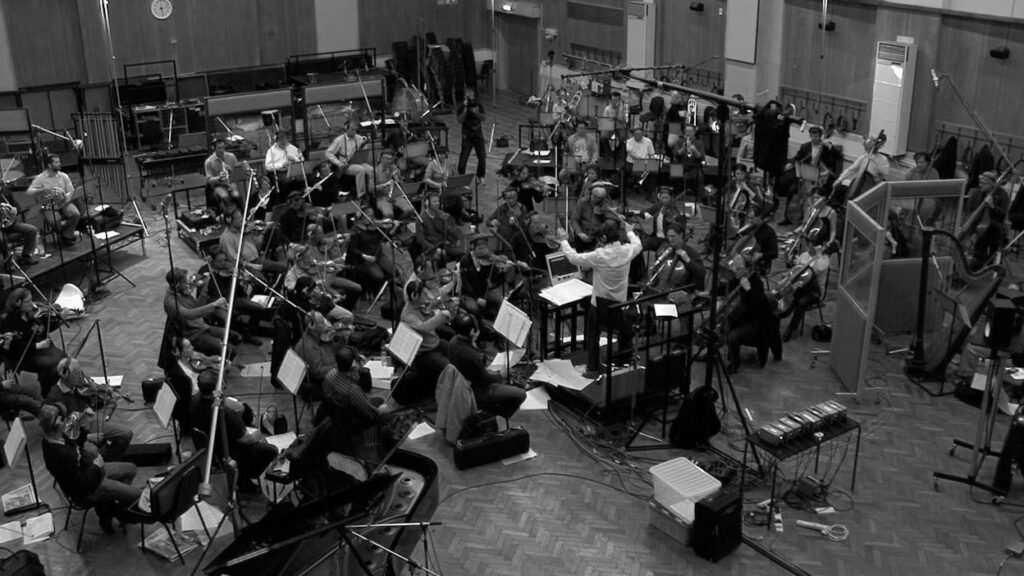
The concert hall is a different world, with different incentives and different judges. It prizes novelty and complexity, and it decides for itself what counts as serious — and the line it draws is often less about the music than about the label attached to the person who wrote it. I can put that concretely. The London Symphony Orchestra recorded my closely detailed orchestral score for 400 Years of the Telescope. Some years later a concert was planned to mark a hundred years of the planetarium — the Zeiss centenary — supported by the International Planetarium Society: a programme of star-inspired music that planetarium audiences had loved over the years, mine among many. It seemed a natural fit. But the NHK Symphony Orchestra declined my score on the grounds that “they don’t do film music” — and, in the next breath, agreed to perform film music by John Williams, an idiom that came out of the concert hall in the first place. They had seen only my website, which described me, at the time, as a composer for film.
I don’t offer that as a complaint; I offer it as evidence. The objection was not to the music — the London Symphony Orchestra had already recorded it — but to a category, and an inconsistently applied one. It points to a genuine confusion about where the boundary of “art,” or of what belongs in a concert hall, actually falls. A composer known for commercial work tends to sit outside that conversation — not through anyone’s villainy, but because the two worlds measure by different rulers, and each is slow to credit the other. Settled judgements give way slowly; that is simply how they work. I find it more useful to understand the mechanism than to resent it.
The concert-hall tradition is, after all, where I come from. I sang for five years as a chorister at Christ Church Cathedral, Oxford; I practised the cello and piano to the level of the concerti; I taught myself orchestration by transcribing Rimsky-Korsakov, Brahms, and Wagner, to learn how the masters wrote for every section. Those years gave me an ear for outlier excellence, and set the standard I still hold my own music to.
But I chose film music, and I chose it as an art and a craft in its own right — not as a consolation, and not as a step toward something more respectable. The orchestra remains my first instrument: acoustic instruments and the unamplified human voice are the sounds I was raised in, and they have earned their place over centuries in a way synthetic sounds have not. To bring that palette to bear on a moving image, and to move an audience who never once thought about how it was done — that is the work. I am content to be judged by it.